by
by 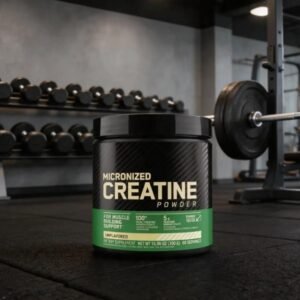 What is Creatine?
If you’ve ever stepped inside a gym, chances are you’ve heard someone recommend creatine. It is one of the most researched sports supplements in the world and has been used safely by athletes, bodybuilders, powerlifters, and fitness enthusiasts for decades.
Creatine is a naturally occurring compound made from three amino acids:
- Arginine
- Glycine
- Methionine
Your body naturally produces around 1–2 grams of creatine every day in the liver, kidneys, and pancreas. It is then stored primarily inside skeletal muscles, where it plays a crucial role in producing quick energy during high-intensity exercise.
Natural dietary sources include:
| Food | Approximate Creatine |
|---|---|
| Beef | 4–5 g/kg |
| Salmon | 4–5 g/kg |
| Tuna | 3–4 g/kg |
| Chicken | Lower amounts |
| Dairy | Minimal |
Vegetarians and vegans often have lower muscle creatine stores and may notice a greater response to supplementation.
 Why is Creatine So Popular?
The popularity of creatine comes from the fact that it consistently improves performance in high-intensity exercise. Unlike many supplements with limited evidence, creatine has been extensively studied across athletes, recreational lifters, and older adults.
Common reasons people use creatine include:
- Increased strength
- Better workout performance
- Improved recovery between sets
- Greater training volume
- Enhanced lean muscle gains
- Better sprint performance
- Potential cognitive benefits under certain conditions
Because of this broad evidence base, many sports nutrition experts consider creatine monohydrate one of the best-value supplements available.
How Does Creatine Work?
Your muscles rely on ATP (adenosine triphosphate) for immediate energy. During heavy lifting or sprinting, ATP is depleted within seconds.
Creatine helps replenish ATP more quickly, allowing you to:
- Lift heavier weights
- Perform more repetitions
- Recover faster between sets
- Train with greater intensity
Over weeks and months of consistent training, this can translate into greater improvements in strength and muscle growth.
| Without Creatine | With Creatine |
|---|---|
| Lower ATP availability | Faster ATP regeneration |
| Earlier fatigue | Better high-intensity performance |
| Reduced training volume | Increased training volume |
| Slower recovery between sets | Improved recovery between efforts |
| Type | Evidence | Recommendation |
|---|---|---|
| Creatine Monohydrate | ⭐⭐⭐⭐⭐ | Best choice |
| Micronized Creatine | ⭐⭐⭐⭐ | Good option |
| Creatine HCL | ⭐⭐ | Limited evidence |
| Buffered Creatine | ⭐ | No clear advantage |
| Creatine Ethyl Ester | ⭐ | Not recommended |
For most people, creatine monohydrate remains the preferred option due to its effectiveness, affordability, and extensive research.
Is Creatine Safe?
This is one of the most common questions people ask.
For healthy adults using recommended amounts, research generally supports the safety of creatine. Studies have followed participants for months and, in some cases, several years without finding evidence that creatine damages healthy kidneys or the liver.
However, supplementation is not appropriate for everyone. People with pre-existing kidney disease, certain medical conditions, or those taking medications that affect kidney function should speak with a healthcare professional before using creatine.
 Scientific Evidence
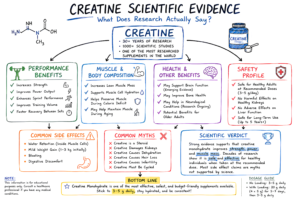
Researchers have investigated creatine for more than three decades. Across numerous studies, creatine has shown consistent benefits for strength and high-intensity performance while maintaining a favorable safety profile in healthy individuals.
Research has associated creatine supplementation with improvements in:
- Maximum strength
- Power output
- Lean body mass
- Exercise performance
- Recovery between repeated high-intensity efforts
These findings explain why creatine is commonly recommended by sports nutrition professionals.
Why Do So Many Myths Exist?
Despite strong research, misconceptions about creatine side effects remain widespread.
Common myths include:
- Creatine damages kidneys
- Creatine causes liver failure
- Creatine causes dehydration
- Creatine causes hair loss in everyone
- Creatine is a steroid
- Creatine is unsafe for beginners
- Creatine causes permanent bloating
Many of these claims originated from anecdotal reports, misunderstandings, or confusion between creatine and anabolic steroids. The available scientific evidence does not support most of these myths for healthy users following recommended dosages.
Creatine Side Effects: The Truth Most People Never Hear
If you search “creatine side effects”, you’ll find thousands of articles claiming creatine causes kidney damage, dehydration, hair loss, infertility, and even heart problems. Much of this information is based on myths, isolated reports, or confusion with anabolic steroids.
Scientific research tells a different story.
For healthy adults taking the recommended dose, creatine side effects are generally mild and temporary. Understanding the difference between evidence and internet myths is essential before deciding whether creatine is right for you.
| Side Effect | Scientific Evidence | Common? | Serious? |
|---|---|---|---|
| Water Retention | ✅ Proven | Yes | No |
| Mild Weight Gain | ✅ Proven | Yes | No |
| Bloating | ✅ Sometimes | Moderate | No |
| Digestive Issues | ✅ Possible | Low | No |
| Hair Loss | ⚠ Limited Evidence | Rare | Unclear |
| Kidney Damage | ❌ No Evidence in Healthy Adults | No | Only with Existing Disease |
| Liver Damage | ❌ No Evidence | No | Rare |
| Dehydration | ❌ Myth | No | No |
| Muscle Cramps | ❌ Myth | No | No |
| High Blood Pressure | ❌ No Evidence | No | No |
1. Water Retention
One of the most common creatine side effects is increased water inside muscle cells.
This is actually one of the reasons muscles look fuller after starting creatine.
Many beginners mistake this for gaining fat.
Here’s what really happens:
Without Creatine
➡ Muscle Cell
With Creatine
➡ Muscle Cell + More Water + Better Hydration + Improved Performance
This intracellular water supports muscle function rather than causing unhealthy swelling.
Is it dangerous?
No.
For healthy people, this is a normal physiological response.
2. Mild Weight Gain
One of the earliest creatine side effects people notice is an increase on the weighing scale.
Typical increase:
| Time | Average Gain |
|---|---|
| Week 1 | 0.5–1.5 kg |
| Week 2 | 1–2 kg |
| Month 1 | 1–3 kg |
This isn’t body fat.
Most of it comes from:
- Increased muscle water
- More glycogen storage
- Increased training performance
3. Digestive Problems
Taking excessive amounts of creatine can sometimes cause:
- Bloating
- Loose stools
- Stomach discomfort
- Nausea
How to avoid it
✅ Take 3–5 g daily.
✅ Drink enough water.
✅ Take creatine with food.
❌ Don’t consume 20–30 g in one serving.
4. Does Creatine Damage Kidneys?
This is probably the biggest myth surrounding creatine side effects.
Myth
Creatine destroys your kidneys.
Science
More than 30 years of research has not shown kidney damage in healthy adults using recommended doses.
Researchers often confuse creatinine with creatine.
Creatinine is a waste product measured in blood tests. Supplementing with creatine can slightly increase creatinine levels without indicating kidney damage.
Who should avoid creatine?
People with:
- Chronic kidney disease
- Reduced kidney function
- Kidney transplant history
- Kidney-related medications
should only use creatine under medical supervision.
5. Does Creatine Damage the Liver?
Another common misconception is that creatine side effects include liver damage.
Current evidence does not support this in healthy individuals using recommended doses.
If you have:
- Liver cirrhosis
- Hepatitis
- Fatty liver disease requiring medical treatment
consult your healthcare provider before supplementation.
6. Does Creatine Cause Hair Loss?
Perhaps the most controversial topic.
Why do people think this?
A small study reported an increase in DHT, a hormone linked to male pattern baldness.
This created the myth that creatine causes baldness.
What does current research say?
There is no strong evidence that creatine directly causes hair loss.
If someone already has a strong genetic predisposition to androgenetic alopecia, the relationship remains uncertain and requires more research.
Verdict
Current evidence is inconclusive, not proof.
7. Does Creatine Cause Acne?
No scientific evidence suggests that creatine directly causes acne.
Acne is more commonly influenced by:
- Hormones
- Genetics
- Skincare
- Diet
- Stress
Many people start creatine alongside intense training and dietary changes, making it difficult to identify the true cause of skin changes.
8. Does Creatine Cause Dehydration?
Another long-standing gym myth.
Myth
Creatine pulls water into muscles and leaves the rest of your body dehydrated.
Reality
Modern research does not support this claim.
Many studies show that creatine may improve hydration status during exercise when fluid intake is adequate.
Still…
Drink:
- 3–4 litres daily
- More during summer
- More if sweating heavily
9. Does Creatine Cause Muscle Cramps?
Years ago, athletes believed creatine caused cramps.
Today’s evidence shows:
❌ No increased risk of muscle cramps
❌ No increase in muscle injuries
❌ No decrease in performance
Hydration remains the most important factor.
Creatine Myths vs Scientific Facts
| Myth | Fact |
|---|---|
| Creatine is a steroid | ❌ False |
| Creatine damages kidneys | ❌ False for healthy adults |
| Creatine causes infertility | ❌ No evidence |
| Creatine causes liver damage | ❌ False |
| Creatine causes dehydration | ❌ False |
| Creatine causes baldness | ⚠ Evidence is inconclusive |
| Creatine causes bloating forever | ❌ Usually temporary |
| Creatine is only for bodybuilders | ❌ Athletes, women, older adults, and vegetarians may also benefit |
Bro Science vs Real Science
Bro Science
❌ You must cycle creatine every month.
✅ Science: No strong evidence shows healthy adults need to cycle creatine.
❌ Loading is mandatory.
✅ Science: Loading is optional. Daily intake of 3–5 g will gradually saturate muscle stores over several weeks.
❌ Creatine works only after workouts.
✅ Science: Timing appears to be less important than taking it consistently.
❌ You need sugar to absorb creatine.
✅ Science: Carbohydrates may slightly increase uptake, but creatine is effective without sugary drinks.
❌ Creatine is dangerous after age 40.
✅ Science: Some research suggests older adults may also benefit from creatine alongside resistance training, provided there are no medical contraindications.
Creatine Loading Phase Explained
One of the biggest debates online concerns the creatine loading phase.
What is Loading?
The loading phase rapidly saturates muscle creatine stores.
Standard Loading Protocol
| Days | Dosage |
|---|---|
| Day 1–7 | 20 g/day (split into four 5 g servings) |
| After Day 7 | 3–5 g/day |
Do You Need to Load?
No.
Many people skip loading entirely.
Taking:
3–5 grams daily
will still fully saturate muscle creatine stores over approximately 3–4 weeks.
Loading vs No Loading
| Loading | No Loading |
|---|---|
| Faster results | Slower saturation |
| More water retention initially | Less initial weight gain |
| Higher chance of stomach discomfort | Better tolerated |
| Optional | Also effective |
Who Experiences More Side Effects?
People who are more likely to experience mild creatine side effects include:
- Those taking very high doses
- Individuals who don’t drink enough fluids
- People using poor-quality supplements
- Those with pre-existing kidney disease
- People taking multiple supplements without guidance
For most healthy adults following recommended dosages, serious adverse effects remain uncommon.
Final Verdict: Should You Worry About Creatine Side Effects?
After decades of scientific research, the evidence is clear: creatine side effects are generally mild and temporary when creatine is taken at the recommended dose of 3–5 grams per day by healthy adults. The most common creatine side effects include temporary water retention, slight weight gain, and occasional digestive discomfort, while many popular claims about kidney damage, liver failure, dehydration, or muscle cramps are not supported by current scientific evidence in healthy individuals.
If your goal is to build muscle, improve strength, recover faster, or increase athletic performance, creatine remains one of the safest, most effective, and most affordable sports supplements available. Choosing a high-quality creatine monohydrate, staying well hydrated, following the correct dosage, and maintaining a balanced diet will help you maximize results while minimizing potential creatine side effects.
Remember that supplements are only one piece of the puzzle. Consistent resistance training, progressive overload, adequate protein intake, quality sleep, and proper recovery will always have a greater impact on your progress than any supplement alone. Creatine works best when combined with a structured workout plan and healthy lifestyle.
At NerdFitness.in, we believe in evidence-based fitness, not gym myths or bro science. Before adding any supplement to your routine, especially if you have kidney disease, liver disease, or other medical conditions, consult a qualified healthcare professional.
Ready to take your fitness to the next level? Explore more expert guides on creatine, workout plans, nutrition, fat loss, muscle gain, whey protein, and science-backed supplements only on NerdFitness.in.